Close

                                           Application Open for Two-Years Full Time PGDM Programmes Batch (2026-28) (Apply Now )   

Fore School of Management
  • Library
  • FORE in Media
  • Campus Tour
  • Alumni
  • Vacancy
  • Tenders
  • Blog
  • Login
    • New Delhi
    • Gurugram
Menu Icon

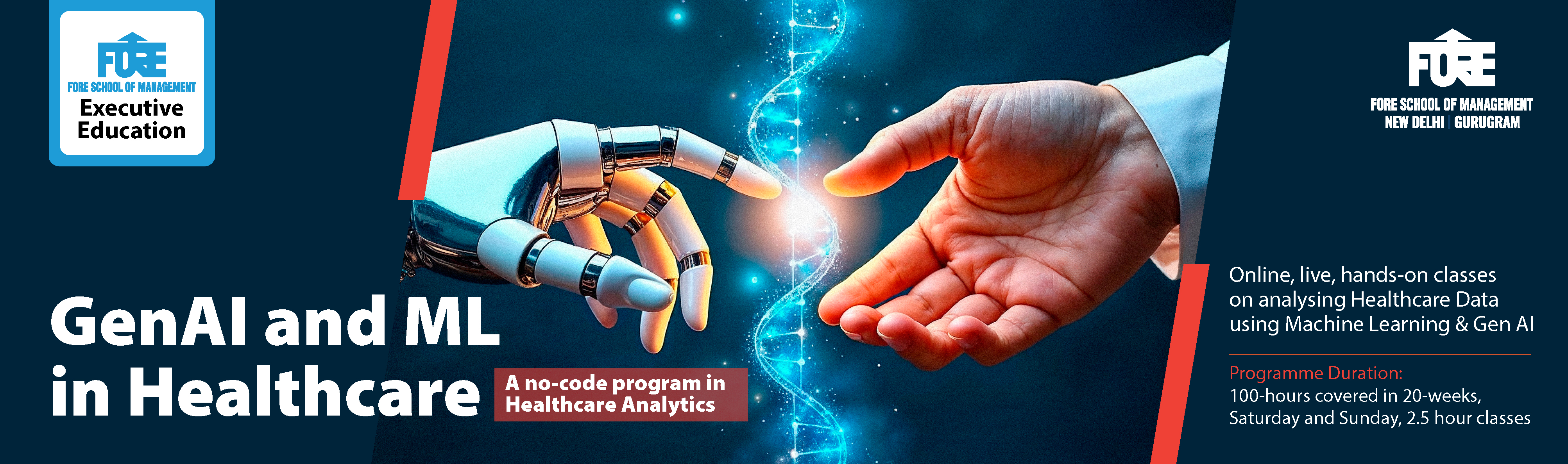
GenAI and ML in Healthcare

Download Brochure

(A no-code, hands-on, interactive online 100-hour program on weekends)

About Program

AI adoption in medical and life sciences has surged since 2019 when COVID struck. In medical and life sciences large datasets are available spurred by digital transformation of hospitals, sensor fitted multiple medical equipment and growth of services around them such as medical insurance.

Application of Machine Learning and Generative AI in healthcare enhances accurate diagnosis, drug discovery, and personalized treatment. These technologies turn complex data into actionable insights, improving clinical decision-making, predictive risk assessment, and operational efficiency.

Primary Objectives

• Develop insights into healthcare data through visual analytics and optimize treatments
• Learn techniques to group/segment data and patients
• Improve patient outcomes through predictive analytics models
• Building clinical decision support systems using Generative AI
• Developing Large Language Model products for medical applications

Course Modules

We have four modules. The first one is Biostatistics. Biostatistics (sometimes referred to as biometry) is a branch of statistics that applies statistical methods to a wide range of topics in the biological sciences, with a focus on clinical medicine and public health applications.

Machine Learning and Deep Learning are being used extensively in health sector. Deep Learning techniques are especially useful for image datasets, for example, chest-X-rays and CAT-Scans. These techniques are also used with sensor data (for example, ECG). If tabular data is sufficiently large, deep learning techniques can also be applied for making predictions.

AI Healthcare

Generative AI and LLM are being developed as Clinical Decision Support Systems (CDSSs): AI-generated CDSSs can provide clinicians with real-time insights to inform treatment decisions and improve patient outcomes.

These modules are totally hands-on, and practise based. These are online, live, and totally interactive lab-oriented Modules with the primary objective of disseminating techniques of Healthcare Analytics using Data Visualization, Machine Learning, Deep learning and Gen AI.

Module Theme Hours
Module I Biostatistics 15
Module II Machine Learning 20
Module III Deep Learning & Text Analytics 20
Module IV Generative AI & Automation 45
Total Hours 100

Types of Questions Answered

Here are several typical or atypical questions that we strive to answer in our program. We will perform Segmentation analysis, Classification analysis, Regression analysis and use Gen AI for CDSS. (Students are welcome to bring their own sample data for analysis)

Clinical Problems

• Classify fetal health in order to prevent child and maternal mortality
• Predict lung function decline—Pulmonary Fibrosis Progression
• Predict Possibility of Heart Attack
• Classify Pulmonary Embolism cases in chest CT scans
• Predict the onset of diabetes based on diagnostic measures
• Predict Age from X-rays
• Predict if an infant is likely to develop autistic tendencies
• Predict severity of epileptic seizure
• Detect Malaria through Infected Cell Images
• Detect Autism from a facial image
• Identify acute intracranial haemorrhage and its subtypes
• MRI Imaging Comparisons of Demented and Nondemented Adults
• Create an accurate model to predict the stage of Alzheimer.
• Distinguishing Different Stages of Parkinson’s Disease

Analytics

Pharmaceutical and R&D Problems

• Predict a biological response of molecules from their chemical properties

Patient behaviour related

• Can you predict if a patient will keep his appointment?
• Prevalence and attitudes towards mental health among tech workers

Insurance and Costs related

• Can you accurately predict medical insurance costs? • Healthcare Provider Fraud Detection Analysis • Explore Health Insurance Marketplace • Predict length of stay in hospital • Predict medical insurance costs • Predict hospital readmission for diabetes patients

Retail purchases and sale

• Forecast sales of drugs using store, promotion, and competitor data

Develop Clinical Decision Support Systems

• Develop CDSS in any field in medical sciences using modern day research

Who Should Attend?

This program is designed for professionals and students looking to apply analytics and AI bridge the gap between Healthcare and Technology.

Life Sciences & Healthcare

Students : Biology, Biotechnology, Biochemistry, Bioinformatics, Cell Biology, Ecology, Molecular Biology, Microbiology, and Marine Sciences.

Clinical Practitioners : Doctors, Medical Practitioners, Nurse Practitioners, and Healthcare Workers.

Specialists : Bio-technologists and Bio-informatics experts.

Analytics

Management & Technology

Leadership :Helping them to optimize operations (staffing, patient flow), predicting needs (readmissions, outbreaks), personalizing care, detecting fraud, and improving clinical decisions

Technical Experts : : Data Scientists, Programmers, and Engineers Analysing massive datasets (genomic, clinical, real-world) to speed up drug discovery, create personalized medicine, optimize clinical trials and improve diagnostics.

Academic Sector : Researchers and those in Academics.

Remote access to GPU equipped lab

Student access our powerful, GPU equipped lab-machines remotely (at no extra fees). When a student works remotely, the experience is as if he is working on his own laptop. Of course, a good Internet connection is desired.

Further, if a student has a laptop or desktop with minimum 16gb of RAM with at least i5 processor, we provide help to install all requisite software in his laptop. This enables a student to store all data and applications in his laptop and these will be available to him even after the course finishes.

No-code Program

We would like to highlight that we cover Biostatistics, ML, DL & Gen AI techniques using ‘No-code’ approach. We use the best, highly reputed and industry standard Graphical User Interfaces (Visual frameworks) that generally use drag-and-drop approach to build simple to complex workflows—to create data pipelines, build models, test them and then deploy for production use. All these tools/platforms are open source, have very liberal licencing policies and can be utilised even with very large data in production environment.

We use the following Visual frameworks to perform analytics, create statistical and predictive models and deploy production environment.them for use in

Software Applied In
JASP & KNIME Biostatistics
KNIME Machine Learning & Deep Learning
H2O Machine Learning & Deep Learning
Flowise Generative AI Apps
N8N Generative AI & Automation and Agentic Solutions
Ollama & Xinference Generative AI: Open source platforms for Large Language models
RAGFlow Agentic AI: Building a superior context layer for AI agents

For more details, please refer to the program brochure.

Executive Education/MDPs

FORE School of Management has been designing, developing and conducting innovative Executive Education (EE)/ Management Development Programmes (MDPs) for working executives in India for over three decades.